

Bereichsnavigation
Venues for musical performances
Two-year theme of the State Institute for Music Research
Wherever a performance takes place with a specific intention, a performance space is created. Interaction between performers and listeners is essential. Intuitively and from experience, concert-goers sense just how strongly the spatial characteristics of a performance can influence the atmosphere, the listening experience and the emotions evoked by a musical event. That is why many performance spaces have been – and continue to be – designed with great care.
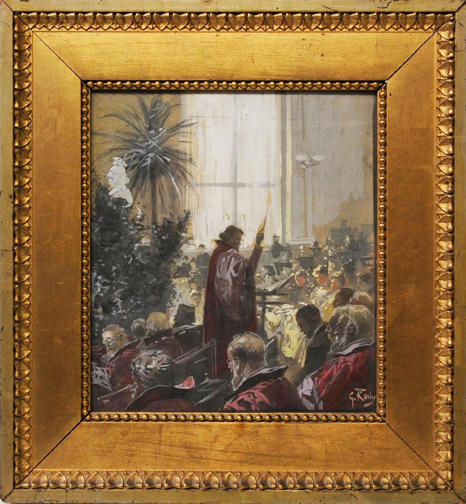
Joseph Joachim conducting at a gala performance by the Sing-Akademie Berlin to mark the birthday of Emperor Wilhelm II on 24 January 1907. Georg Koch; watercolours and graphite pencil on cardboard; 1907. Museum of Musical Instruments, Berlin, Inv. No. MIM B 342. Photo: SIMPK/Sabine Hoffmann
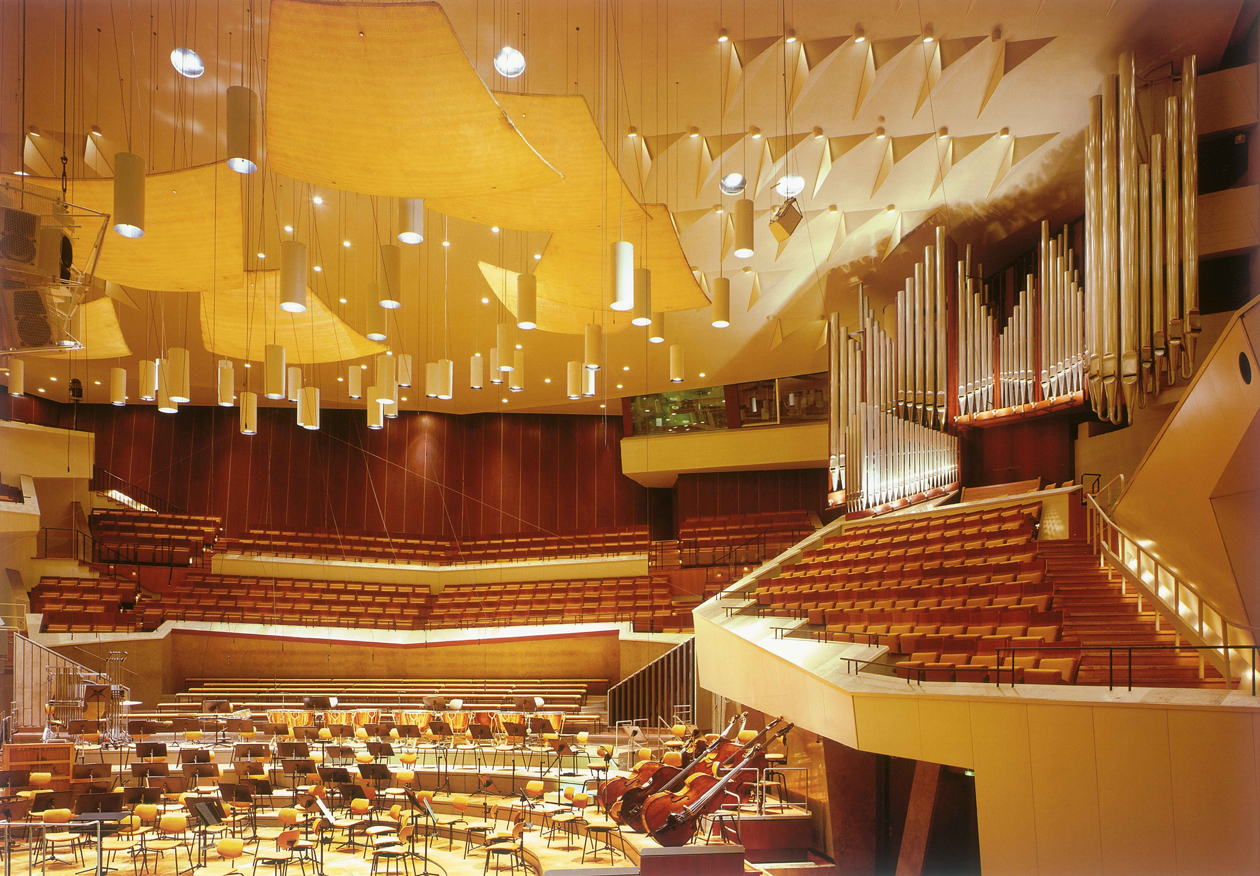
An understanding of acoustics was already fundamental in ancient theatre architecture and is now a given in the design of modern concert halls. Yet the impact of such spectacular concert venues as the Berlin Philharmonic, the Elbphilharmonie in Hamburg or The Sphere in Las Vegas extends far beyond the acoustic experience itself. Such extraordinary concert venues shape the cityscape to such an extent that they become architectural icons and landmarks of a city.
In tandem with developments in media technology, the potential venues for musical performances have been expanding ever since the introduction of sound recordings, radio and visual media. Even before the invention of sound film, moving images were set to music, including through the use of musical instruments developed specifically for this purpose, such as the cinema organ. An impressive example – the American cinema organ ‘Mighty Wurlitzer’ – can still be heard today providing live accompaniment to the silent film series at our musical instrument museum.
Music was also played, recorded and broadcast live in recording studios, on the radio and, later, on television. The resulting physical separation between musicians and audience transformed the listening experience of musical performances. Since the COVID-19 pandemic, at the very latest, it is not only the audience but also the performers playing together who are no longer necessarily physically together. The virtual or digital performance space raises new questions about the technological possibilities of live musical broadcasting, but also about the social experience of musical performance.
Staff from all three departments of the SIM are exploring this range of topics as part of the two-year project ‘Performance Spaces in Music’. In this context, ‘performance spaces’ are understood not only as physical spaces, but also as places of encounter and social spaces for communication and the dissemination of knowledge and scholarship – a concept that plays a particularly important role in a museum context.
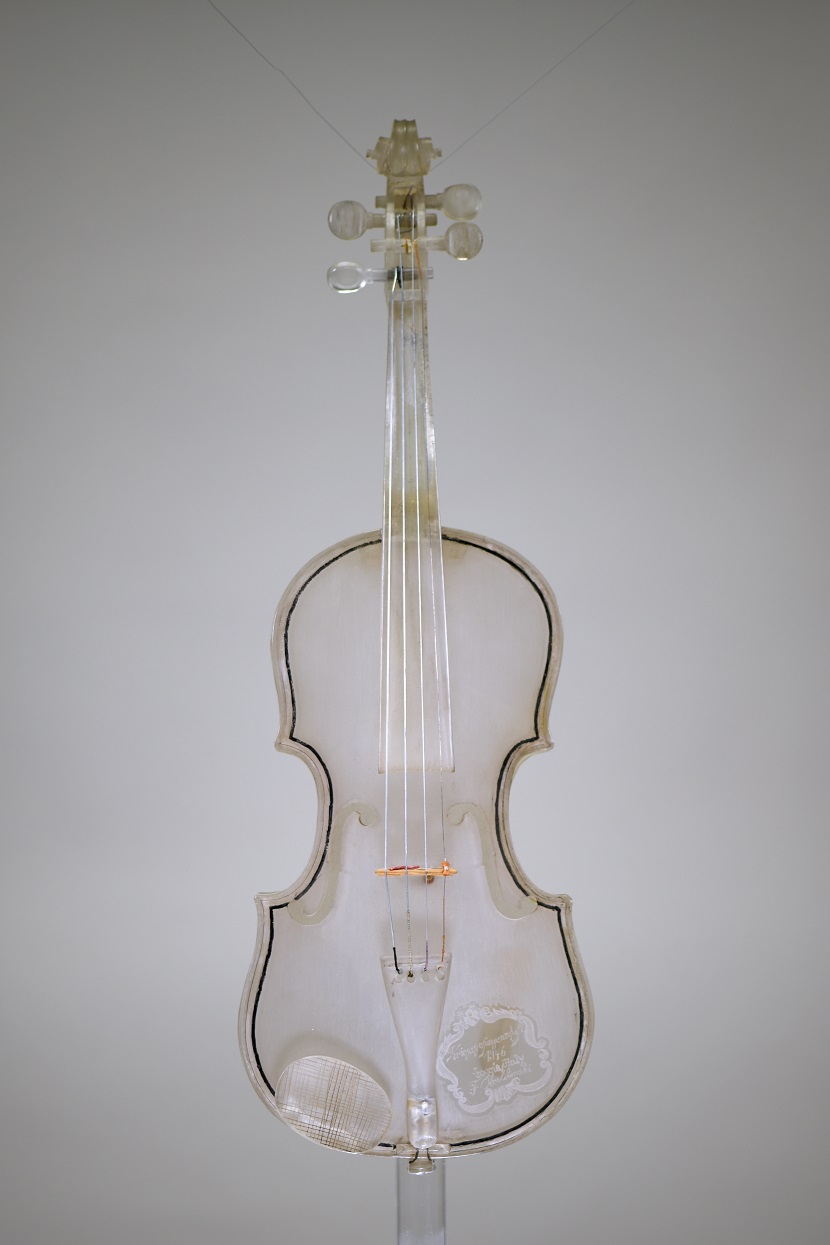

Plastic violin, Museum of Musical Instruments, Berlin, cat. no. 4217. Photos: SIMPK/Barnes Ziegler
Musical instruments from the MIM collection also bear stories about venues for musical performances. Alongside the cinema organ, another example leads us to an extraordinary performance venue. It is a violin made of transparent plastic, the inscription on which draws attention to where it was made: ‘Prisoner of war camp, Foggia, Italy, 1946’. It is well known that music was played in prisoner-of-war camps, but the fact that such unique musical instruments were also crafted on site merits closer examination and raises the question of how instruments and music shaped these places and spaces, and whether and how these spaces and places in turn influenced instrument-making.
The project also focuses on outdoor performances. Attention will be directed, amongst other places, to the Berlin Kulturforum – the site where the State Institute for Music Research has been based for 40 years. The anniversary was celebrated with a symposium on the theme ‘The Berlin Kulturforum as a Sound Space’.
For the interdepartmental work on the theme of ‘Spaces for Musical Performance’, this anniversary provides an opportunity to illustrate the various methodological approaches in contemporary music research using concrete examples. The project will culminate in a book, which is expected to be published in 2026.
Project Lead
Period
2023–2026
Project management
Recent publication
Events
- Heinz von Loesch and Stefan Weinzierl: “The Berlin Philharmonie – Spatial Philosophy and Acoustics” (SIM Research Colloquium, 17 June 2026)
- Flavia Hennig: “Exhibition and Performance. The Folklore Hall of the MIM” (SIM Research Colloquium, 22 April 2026)
- 2025 Series “Musical Interpretation and Performance Spaces”
- Triple Helix (13 February 2025)
- Experimental concert: Musica bizzarra (16 January 2025)
- 40 Years of SIM at the Kulturforum (14–15 December 2024)
- Corinna Herr: “Musical Interpretation in the Digital Space: Classical Music on YouTube” (5 December 2024)