

The Queen of Cinema Organs meets the Ruler of the Night
News from 10/22/2026
For the past ten years, the Mighty Wurlitzer has been providing the musical accompaniment for silent films at the MIM’s Wednesday cinema screenings. To mark this anniversary, the programme features Murnau’s *Nosferatu*, comedies by Ernst Lubitsch and Wilhelm Thiele, and a drama starring Brigitte Helm from *Metropolis*.
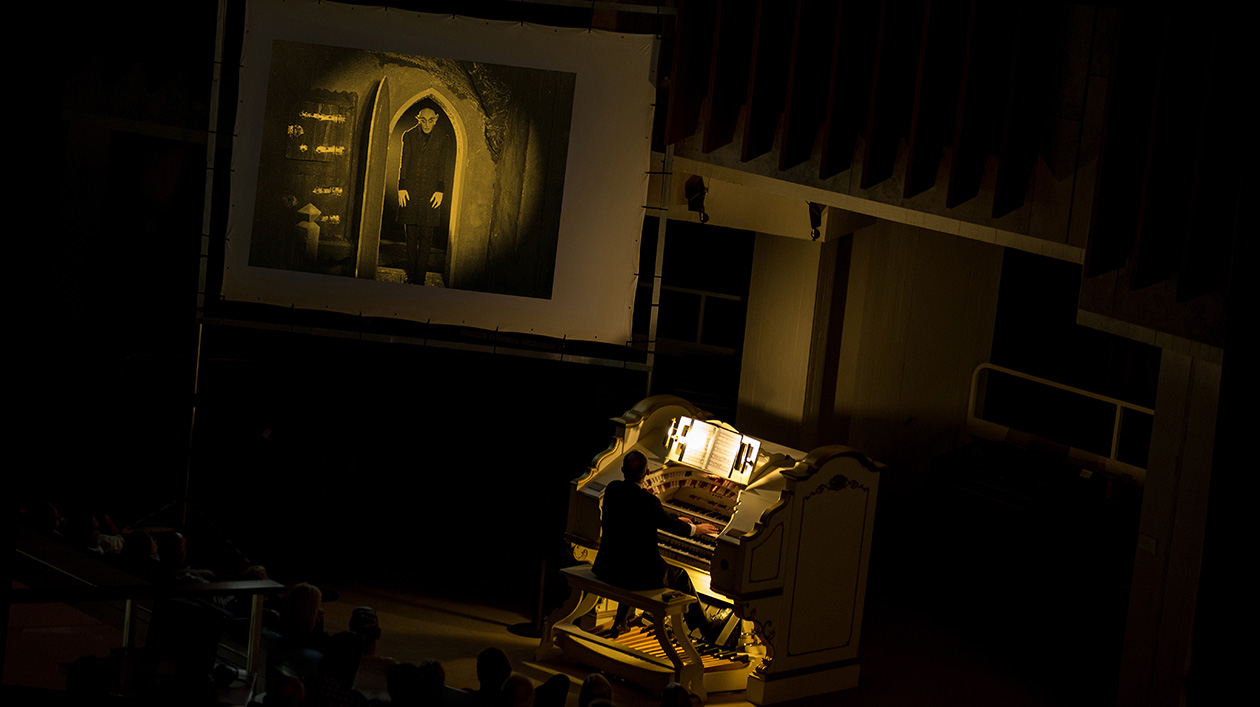
To kick things off on 18 November, Jörg Joachim Riehle will provide the musical accompaniment to Friedrich Wilhelm Murnau’s *Nosferatu* (1921). One of the earliest surviving vampire films in cinema history is an icon of the horror genre and a masterpiece of German Expressionism. When Count Orlok takes to the screen, the Mighty Wurlitzer creates the perfect atmosphere with its powerful orchestral sound and dramatic effects.
The programme on 16 December demonstrates that the mighty theatre organ is equally at home with light-heartedness and humour: The programme features two early comedies by Ernst Lubitsch, “When I Was Dead” (1915) and “I Don’t Want to Be a Man” (1918), accompanied live by Anna Vavilkina.
This is followed on 13 January by Hanns Schwarz’s melodrama “Die wunderbare Lüge der Nina Petrowna” (1929), starring Brigitte Helm, who made her breakthrough two years later in Fritz Lang’s *Metropolis*. Sorin Creciun will be at the Mighty Wurlitzer. Wilhelm Thiele’s turbulent comedy “Hurrah! I’m Alive!” (1928) brings the season to a close on 10 February. Bernd Wurzenrainer will provide the musical accompaniment. Thiele is regarded as one of the pioneers of the sound film operetta and is best known today for the musical film “Die Drei von der Tankstelle” (1930).
The Mighty Wurlitzer theatre organ at the Musical Instrument Museum is one of the largest instruments of its kind on the European continent. Werner Ferdinand von Siemens acquired it in 1929 from the Wurlitzer Company in the USA. Like all large theatre organs, it combines the sonic possibilities of an orchestra with numerous sound and special effects. With sounds ranging from eerie and dramatic to cheerful and lively, it lends the films their very own atmosphere.
The Wednesday Cinema at the Musical Instrument Museum of the State Institute for Music Research brings the tradition of musical silent film accompaniment back to life. The screenings demonstrate how closely the history of silent film is linked to the development of its musical accompaniment – and invite you to rediscover classic films and experience an extraordinary instrument in action.