

AIMC 2026: How AI is changing the way we make music
News from 09/22/2026
The 7th Conference on AI Music Creativity at SIM brought together the latest developments at the interface between artificial intelligence and musical creativity.
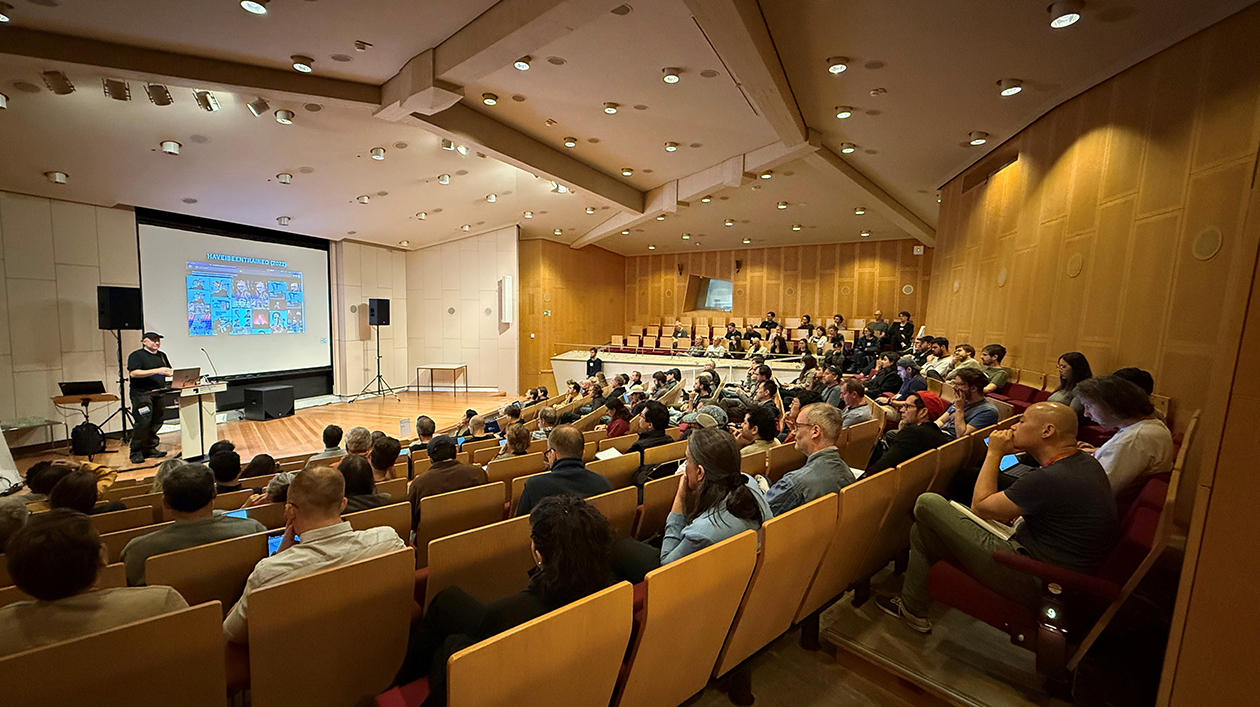
The event was hosted by the State Institute for Music Research of the Prussian Cultural Heritage Foundation (SIM) in collaboration with the Department of Audio Communication at the Technical University of Berlin and the Berlin University of the Arts. It took place at the SIM’s Museum of Musical Instruments.
Under the title ‘The Generative Turn. Mediated Musicianship in a Hyper-reproductive Age’, international researchers, artists and developers discussed how composing, improvisation, performance and production are changing as, on the one hand, AI systems increasingly become part of the musical process themselves and, on the other, the proportion of music that is partly or entirely AI-generated is rising rapidly within the overall music repertoire.
It became clear that the crucial question is not merely what AI can produce musically, but how its integration is changing the conditions under which music is made.
The two keynote speeches by Anna Xambó and Mat Dryhurst were particularly noteworthy. In her performance-based keynote ‘Inventions for Machines: Live-Coded Dreams’, Anna Xambó, a musician and researcher, combined live coding, machine listening and Creative AI with sounds and images from the Musical Instrument Museum and its surroundings. In doing so, she focused on aspects that cannot be readily translated into data and algorithms: place, memory, environment and embodied musical knowledge. Her work demonstrates that, whilst AI can expand musical processes and convey them in new ways, creativity always arises within specific situations, bodies and environments.
Mat Dryhurst shifted the perspective from musical applications to the infrastructures behind AI. His keynote, ‘AI + Music = Coordination’, explored how models, software, data and rules themselves become a field for artistic and social creation. His long-standing collaboration with Holly Herndon – including on Holly+ and the organisation Spawning – combines artistic practice with questions of data rights, authorship and control over technological infrastructures. In doing so, Dryhurst drew attention to a level that is just as crucial to the future of music as the actual generation of sounds: who determines the rules according to which AI systems are trained, deployed and made accessible – and who benefits from this?
The academic papers demonstrated just how broad this field has now become. One key focus was on human-AI networks in musical practice: research covered, amongst other things, AI-assisted improvisation, real-time composition, new forms of interaction between musicians and generative systems, and interfaces that allow neural sound models to be musically controlled. Presentations on collaborative piano playing, live performance, live coding and interactive musical agents made it clear that AI is increasingly understood not only as a tool, but as part of a complex musical action system.
Other contributions focused more closely on the aesthetic and epistemic implications of generative systems. How can AI-generated music and its quality be evaluated at all? Do generative systems develop their own aesthetic characteristics – or do they tend to lead to a homogenisation of musical styles? How does the role of intention, virtuosity and authorship change when musical decisions are distributed amongst humans, models, datasets and interfaces? Research on text-to-audio models, neural synthesis, machine listening and the evaluation of generative music demonstrated that these questions are no longer merely theoretical in nature, but are directly linked to the development and use of specific systems.
Another cluster of topics concerned the social and cultural conditions of AI music. Papers addressed training data, cultural identity, authorship and the question of how musical labour and value creation are changing. The use of generative AI in music education, questions of accessibility and new forms of music-making with digital instruments were also examined. In doing so, the conference broadened the perspective from the technical capabilities of individual models to the cultural and social systems in which these technologies are deployed.
The workshops and artistic presentations brought these issues to life through practical experience. The workshop ‘Dialoguing with Improvising Machines’ examined musical agent systems from the perspective of collaborative improvisation. The tutorial ‘Computer-Assisted Composition: From Survey to Studio Workflows with MIDI-GPT’, on the other hand, focused on the practical application of generative systems in compositional and studio workflows. Finally, the concerts and performances showcased numerous forms of AI-mediated musical practice – ranging from live improvisations and neural sound synthesis to interactive and embodied instruments.
As a result of AIMC 2026, what can be noted above all is a shift in perspective: AI in music is no longer merely a question of the automated generation of melodies, sounds or entire pieces. The focus is increasingly on a complex network of people, machines, data, interfaces and infrastructures. Creativity appears less as the achievement of a single creator or a single system, and more as a process in which different forms of agency interact. At the same time, the conference demonstrated that, with these new possibilities, questions of authorship, responsibility, data, control and musical value creation are gaining in significance.
The AIMC 2026 did not, therefore, present a single, unified vision of the future of AI music. Rather, it highlighted just how diverse the musical possibilities and unresolved questions already are today. Between live coding and machine listening, between creative collaboration and data infrastructures, between artistic experimentation and critical reflection, one thing became clear: The ‘Generative Turn’ is not merely changing the tools with which music is created. It challenges us to rethink what musical creativity is, who is involved in it – and under what conditions music will be made, listened to and shared in the future.