

Bereichsnavigation
Berlin Recording Venues, 1900–1945
Sites of the Phonographic Industry in Times of Global Crises
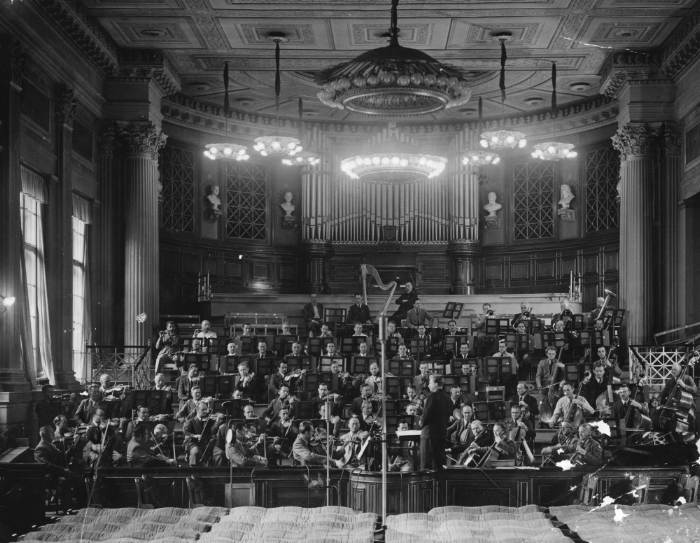
Among the approximately 16,000 historical sound recordings preserved in the collections of the SIM are around 10,000 recordings produced in recording facilities in Berlin during the first half of the twentieth century. Some of these sites have since been destroyed, whereas others remain in existence today. These recordings document a period in which Berlin became the principal centre of the German phonographic industry. Following the establishment of the phonograph by Thomas Alva Edison and the gramophone by Emil Berliner, roughly a dozen companies were founded around the turn of the century, dedicated to the production of acoustic sound recordings encompassing all musical styles and genres for an international market.
Drawing on objects from the SIM collection, the project approaches these recordings through the architectural spaces in which music was recorded and produced. By focussing on the environments of sound recording, it seeks to reconstruct and communicate an important aspect of Berlin’s cultural and economic history. The research project, Berlin Recording Spaces, 1900–1945: Sites of the Phonographic Industry in Times of Global Crises, aims to provide both a comprehensive overview and detailed case studies of the premises in which sound recordings were produced over a period of more than forty years – initially by purely mechanical means using the recording horn and, from 1926 onwards through electrical employing amplification and the microphone. It will investigate where these recordings were made and what physical and architectural characteristics these environments possessed.
The project will identify, digitise, and document representative recordings produced by different companies in about twenty recording spaces between 1900 and 1945. These recordings will be contextualised by integrating available evidence, including metadata, contemporary trade publication, archival records from the Landesarchiv Berlin, the Geheimes Staatsarchiv Preußischer Kulturbesitz (GStA), and the Deutsches Technikmuseum, as well as historical photographs and other visual materials.
A central objective is to assess the extent to which the surviving phonograms preserve acoustically perceptible traces of the spaces in which they were recorded. The project will further examine whether interactions between recording environments and recorded performance can be identified. At the same time, it will consider the alternative hypothesis that the historical recording space functioned merely as a technical facility whose specific spatial characteristics left no discernible trace in the finished audio recording. Addressing this question has broader implications for our understanding of historical recording conditions, the willingness of performers to adapt to the emerging recording medium, and, ultimately, the development of a distinctive aesthetics of recording and musical performance.