

Bereichsnavigation
Was ist eine Orgel? Auf dem Weg zu einer neuen Geschichte des Instruments
Ein dreimonatiger Forschungsaufenthalt am Staatlichen Institut für Musikforschung
Wie lässt sich die Geschichte der Orgel neu erzählen? Die Musikwissenschaftler Annette Richards und David Yearsley forschten drei Monate am SIM. Die Sammlungen des Musikinstrumenten-Museums und der wissenschaftliche Austausch in Berlin gaben ihrem Buchprojekt wichtige Impulse.
A Research Stay at the Staatliches Institut für Musikforschung
Guest researchers Annette Richards and David Yearsley 3-Month Research Stay, March-May 2026
July 7, 2026
For three months from March to the end of May this year, we were generously hosted by the SIM as guest researchers supported by the Alexander von Humboldt-Stiftung, while we worked on our co-authored book, Wind, Metal and Wood: A [New] History of the Organ slated for publication by Cambridge University Press three years from now.
Our primary work while in Berlin was to conduct a thorough review of recent and not-so-recent scholarly work on the organ and its history as we refined the main methodological questions for the project. German organ culture has long lain at the heart of the history of the instrument, and German scholarship on the organ is central to our study. Library resources and colleagues at the SIM have helped us to consider the large question of how to write the history of an instrument, especially one as complex as the organ. How do material and political histories intersect with musical ones? What is the specific position of the organ within German cultural and organological history? How can we think beyond traditional histories of the organ to formulate new ideas with regard to sound, space, and technology?
Throughout our stay, we made intensive use of the excellent bibliographic and reference resources of the Institute, which allowed us open, efficient access to a range of materials crucial for building solid foundations for the book.
On May 6th we delivered our SIM colloquium/lecture, "Towards a New History of the Organ," in the Curt Sachs Saal at the Institute. Inspired by the vital, thought-provoking questions from, and further encounters with, colleagues at the Institute and in the museum, we proceeded to pursue our account of technological developments (winding systems and playing interfaces, i.e., keyboard and stop actions) and raw materials (various woods, ivory, various metals, and then—in the age of colonization and industrialization—rubber and plastic).
During this period, Annette also worked on an essay on the Hammond organ in mid-20th-century America, which she presented at a Study Day co-organized by colleagues at Oxford and Harvard Universities; that essay, which sketches out the main themes that we will develop at greater length in the last chapter of our book, will be published in Keyboard Perspectives this Fall. David contributed various articles to the ongoing online Encyclopedia of the Organ edited by noted scholar Kimberly Marshall.
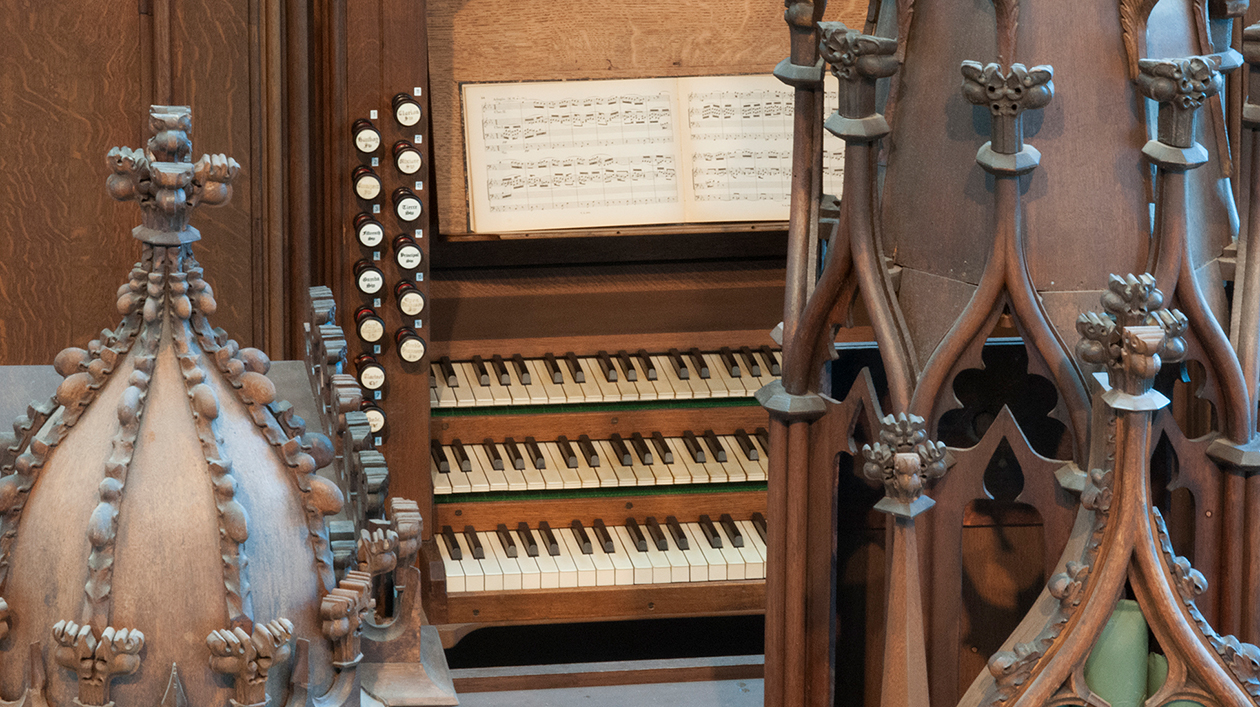
The Staatliches Institut für Musikforschung and the Musikinstrumenten-Museum in Berlin proved ideal institutions for research into the history of the organ. From the humble renaissance regal to the English 19th-century organ (Gray brothers, 1815-20), to the mighty Wurlitzer, to the Trautonium (invented in Berlin in 1930), the museum’s holdings offer the historian unprecedented insight into the intersection of technological innovation, material history, and utopian thinking, to ask the fundamental question: what is an organ?
We are deeply grateful to the Humboldt Stiftung for their support, and to our colleagues at the Staatliches Institut with whom we very much hope to stay in contact as we research and write our book. We hope to return to Berlin to continue to work alongside our new colleagues at the Staatliches Institut, whose perspectives on instruments and instrumentality, spaces, and media, has already encouraged us to refine our approach to our new history of the organ.

